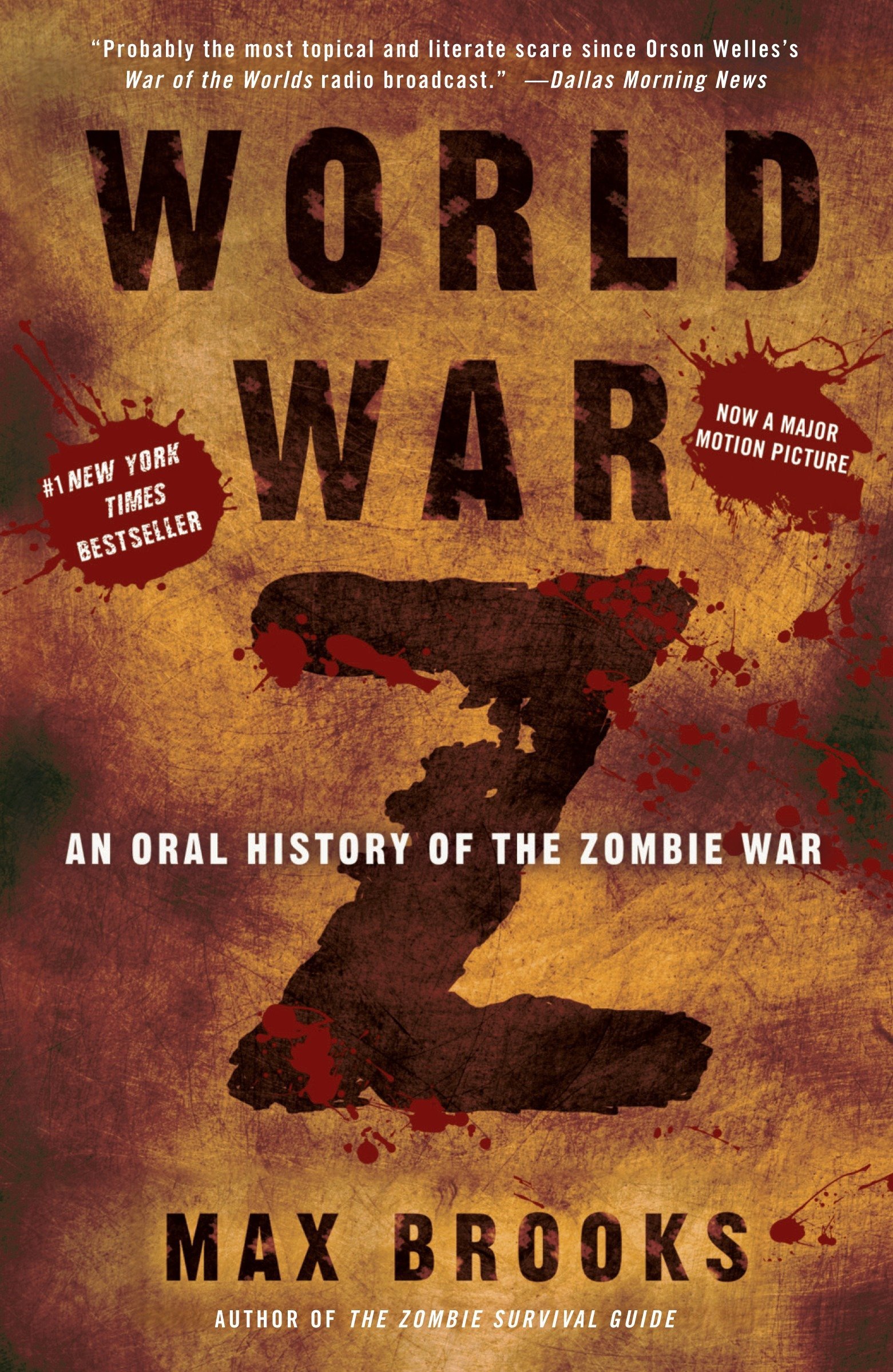
I'll start with the negative to end with the positive. I strongly dislike reading stories that lack a central character, and that is exactly what Max Brooks' has done in World War Z. I had extreme disinterest in it, and it felt like reading a dry textbook about something I didn't care about.
I began reading the book
several weeks ago and tried to do chunks of it to push through. I found myself
looking for excuses to not read or sitting down to read and falling asleep
after one chapter. I tried playing quick games in between readings to give
myself a brain break but the whole thing just drug on forever. While I could
hold my attention through a single chapter/character, I couldn't link them all
together.
That is, unfortunately, my overall opinion of the book. I had high
expectations because my friends loved it and I’d heard that it was excellent,
but in the end, it just isn’t something I’m interested in reading in a novel
format.
What I did like about this book was the idea behind the approach.
It was done better, I think, than King’s Cycle of the Werewolf, which I felt
was similar in execution. I think Cycle’s transition from segments of a story
to a main character just made the first half of the novella weak in comparison
to the last half. World War Z is significantly longer and wider in scale. I
like how it is showing interviews from all over the world to make the epidemic
feel that much bigger. It reminds me of the extra content that comes with the
Game of Thrones dvds with all of the major figures retelling the execution of
the Mad King and the war. It shows how everyone experienced the same event in a
different way.
Brooks also did an great job of changing the voice to fit the interviewee.
I don’t think that all of them were completely distinct from one another, but
there were several that stood out. When I look at the chapters as individual
short stories, there are two that really stuck with me. “Bridgetown, Barbados,
West Indies Federation” and “Topeka, Kansas, USA.”
Bridgetown is the hired mercenary protecting the rich. What I
liked most about this was I felt this was the mostly likely scenario to happen.
I loved the character’s voice and the mannerisms expressed in what he says. I
like how honest he is about what happened and how he reacted. His human
connection shows through and he isn’t just a badass willing to kill frightened
people even though he’s being commanded to. Just, overall, I like this guy
best.
Topeka is the girl that is in an asylum. I like this one for the
character’s mental state, what happens in her tale, and how she tells it. I
think this chapter can hold its own more than any of the others. They’re all
pretty well rounded, but this one just holds every element that a story needs.
It creates the scenario, puts little bits that call back by the end with her
mother nearly killing her. I just felt like I was in this character’s head more
than any of the others I’d read. I honestly felt like my chubby grandma Bobbie
was hugging me with her big soft wing arms. But she died a few years ago so
then she’d probably be a zombie if she was really hugging me.
So here I work my second half of the post with something positive.
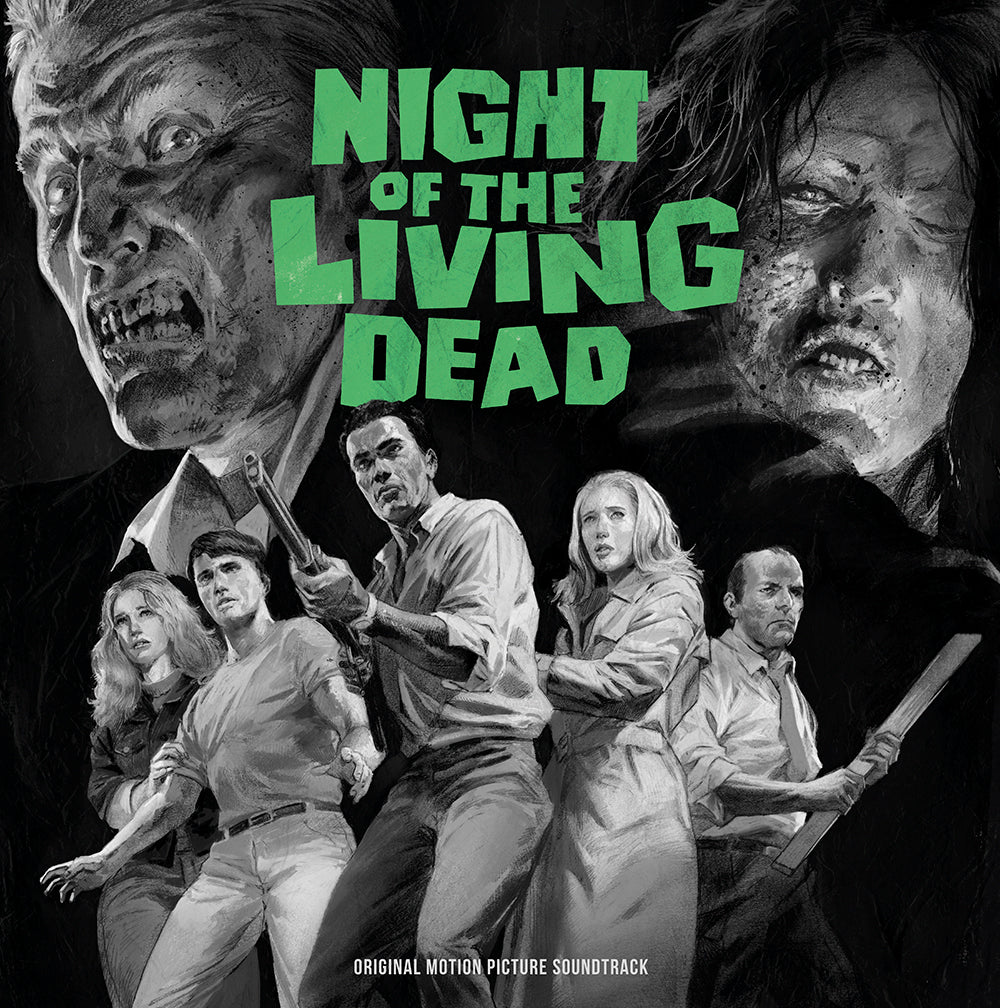
I’ve never seen “Night of the Living Dead” and it was incredibly fun to watch.
I watched the black and white version (in HD!) because I figured the original
would look better than the colorized. At this point in the world, I don’t think
this could be scary for anyone with how desensitized we are. It certainly wasn’t
for me, but I thought it was amazingly funny and wonderfully put together considering
its age. Even though I’ve not seen this until now, I was aware of the fame of
the beginning without even knowing where it came from. “They’re coming to get
you, Barbara!” I knew when it was said that I’d heard it before. I think I even
said it with Johnny the first time he said it.
I had a feeling that this movie was going to be one of those “firsts”
movies. When I was discussing it with my coworker, who was a film major, he
confirmed it by telling me how Duane Jones as Ben was the first, or one of the
first(?), movies to ever cast someone that wasn’t white as the hero. I’m also
thinking Romero is the foundation of zombies.
I loved Ben and I was rooting for him throughout the film, so when
he died, although I kinda saw it coming, I was pretty disappointed. His
character was steadfast, resourceful, and headstrong, and inevitably lead to all
of their deaths (at least I think he did.) Obviously he shot Cooper which led
to his death, but he also put his torch down beside the truck which I
immediately yelled at him for in my bedroom movie theater. I also thought Tom
was stupid for flailing the hose with gas everywhere then thinking it was a
good idea to aim it at the truck.
I feel the characters that really made the story were Ben and
Cooper. The women felt overly flat, which was disappointing, and Tom was too
quick to change his mind on everything making him feel cheap. Ben and Cooper
are nearly the same with their critical difference being their choice of place
to camp out. This obviously creates the majority of the tension in the film
aside from the encroaching horde of “living dead.” I felt like I could get on
board with both Ben and Cooper, so I think Tom is who I feel most closely
related to. I suppose, all in all, each character was pretty flat, but they all
served a purpose in creating constant tension leading to the death of everyone.
I guess if they were all willing to change, or learn from their mistakes, they
would have survived.

You and Shoe both brought up the character situation for Z. I honestly don't remember a single character name aside from setting and what was happening. I had the sleeping issue with I Am Legend, so I can only imagine how getting through this one felt due to the length.
ReplyDeleteI also enjoyed the interview style. It is something different, and helped a lot with my OCD on when I can put the book down for a break. Brooks, despite character connections, was extremely image based. I felt like I was reliving many of the survivor's tales as I read them.
Nice on combining the two posts. I wasn't sure so I separated mine because of anxiety measures. Night of the Living Dead was good for its time. It is also a classic, and I try and tell everyone coming into Horror as new fans to become familiar with most of the classics, even if they are not writers. Movies have plot standards they should be compared to, same with the idea of horror television shows. So, I was happy this was on our list. Most of us seem to agree that Ben was the only likable character.
Hi Vincent, yeah the gasoline, fire, truck combo makes me yell at the TV too. The movie has a lot of weak plot points but I enjoyed it a lot more than WWZ. NOTLD has a unique, auteur's vision that WWZ lacks. Obviously, different media, time periods etc. but one stands up and the other falls flat.
ReplyDeleteI agree that the feel of WWZ was like that of Cycle of the Werewolf, but I thought this one was better than King's personally. Some of the chapters in King's book felt like filler and not needed, while every chapter in WWZ felt different and unique because of the varying voices and societies surrounding those people. I couldn't remember the asylum girl's name, but goodness it was such a good chapter, I agree with you. It was interesting to hear it told from the POV of an unreliable narrator and have to read into the line to learn her mom had tried to kill her. Makes me think of a story I wrote for undergrad that was told from the POV of a child.
ReplyDeleteI'm glad I wasn't the only one who combined posts! Regarding WWZ, I think that's a great comparison between the novel and the extra content of Game of Thrones. I haven't seen all the extras, but I think the comparison holds even for GoT as a series. Ironically enough, I hated GoT when I read the novel around the same time as I first read WWZ, which I loved. I just couldn't get into a book like GoT without being able to connect to a main character, but I didn't have that problem with WWZ—maybe because the narrator as introduced to us in the preface felt like enough of a continuous thread to tie the story together. Or maybe it was because even without a central character I still had a strong sense of the "story"—whereas for GoT, I wasn't really sure what the big picture was outside of what individual characters were doing (although now that I've seen the show, I've gone back and am midway through re-reading the first book—and I love it!).
ReplyDeleteWe had opposite opinions on Night of the Living Dead as well—I thought it was all but unwatchable. The zombies weren't frightening and the characters were excruciating caricatures. It's interesting you say that Ben and Cooper struck you as similar (though wishing to establish their bases in different places)—I hadn't thought of it like that, but I suppose you're right. Still, I felt like Cooper was extremely selfish (he almost didn't let Ben back in the house), while Ben was willing to risk his own life to protect the group. I also was disappointed that Ben died in the end, although I appreciated the choice from a story-telling point of view. Especially since he was the only Black man in the movie, it felt particularly poignant that he was the one shot by the police despite having survived the zombie threat.