I will admit, I do not enjoy reading King's writing, (but I do like the film and tv adaptations) so right away I had a distaste for The Cycle of the Werewolf. I tried to look at it with an open mind, then the presentation just broke that resistance I had and strengthened my dislike.
I would like to, first, talk about what I thought did not work with the story, without focusing on King's writing voice, and I mean voice as in the characteristics that carry from story to story. For me, and this is all just personal bias on any novel or novella of the sort, the culmination of short stories to create a larger one is bad at keeping interest. I want a character I can care about from the beginning, not half way through the novella. This is one of those scenarios where I think the story would have been better as a short story starting with Marty. The story is already short, and I feel the first few months/chapters are wasted text.
The presentation of the werewolf is dull, but I let this slide as I was reading because I know the book is older and there have been a lot of adaptations of werewolves since then. Because there was no mystery to it, I did not see the relevance of having the short stories of each victim other than it being an experimental way of telling the story of a year through months. Even then, the inconsistency of length between chapters bothered me. It was a sigh of relief when July started, only because there was finally something to hold onto. However, because of the brevity of previous characters, I was taken out of the story thinking I was wasting time reading into a kid that is just going to get strewn through the wheels of his chair and hug somewhere iconic for everyone to see.
After July, I felt the story picked up and became something. It felt better woven together with a purpose or message to convey. I liked how October panned out and the jump between Marty and Reverend Lowe through the end of the story. The validation of the Reverend's killings made him a far more interesting monster character than he was portrayed as in the beginning. So I suppose the beginning spoiled the rest of the story for me.
Then the ending came, and I was disappointed once again. It felt too predictable and easy.
I think, all in all, my dislike of what I see as an ADD style of writing (the insertion of random thoughts or actions to build character that don't otherwise serve purpose to the story), took the reins over my ability to appreciate it. I know King is a popular author, and I think many of his stories are very well thought out. I just prefer to watch them on the big screen.I know there is a film adaptation called “The Silver Bullet” which I have not seen, so I am curious if heavy edits were made since King also wrote the screenplay for the film.
Friday, September 27, 2019

Friday, September 20, 2019
Rawhead
"Rawhead Rex"
was definitely an interesting read. I found the world to not be all too
interesting, but Rawhead was a fresh monster in my book of monsters. I read the
copy which has been adapted into the graphic novel, and I'm not sure how I would
have imagined Rawhead to look without the influence of the artwork. I think I
would have seen him in a way that looks like the Cheshire cat, but a little
more pocked in the face since it was described as pitted. I suppose the
paintings in the comic were close to how I envisioned the king as described.

This is my first time
reading anything by Clive Barker, which I'm now learning that he is one of the better-known
horror writers, and I will say that the thing that I liked the most about this
story was his voice. There is one line that I had to stop at, and it stuck with
me throughout the rest of my read. It is so simple, but an image I can see very
clearly in my head. It takes place just after Rawhead kills the ranch family
with the horse.
Rawhead watched sergeant Gissing's car crawl out of the village and along the north road, the headlights making very little impression on the night.
It really is very
simple. It is not necessarily beautiful or poetic, but there is something about
the way he described this scene that made me feel immersed. I'm always
impressed by less is more style of writing. Exact wording, where if any word is
removed the mood is lost. I remember having to talk about this while studying
Fitzgerald's "The Great Gatsby" in one of many different classes. Not
a fan, personally, probably because every professor seemed to want to work on
this story. But I remember talking about the number of edits before publishing
being somewhere around 16, and people claimed that not a single word could be
removed without ruining the story. I didn't read Rawhead the way I did Gatsby,
but I would assume Barker's story would suffer if anything were removed.
One of the aspects I
liked most was the lore created around the monster which led to his standout weakness,
pregnant women. While this is unique, I think it left some questions for me
about why menstruating women were considered sour to him when a woman
during menstruation can't be pregnant. I felt like this should have been the
women's weak point against Rawhead. If it was better explained and I'm missing
something, then it is something to ignore. I did notice that while he only
really turned from one woman, he wasn't really drug through any other areas
with women that weren't children. The only adultish people he really maimed
were male. Still, I wondered if his only reasoning for being afraid or weak
against pregnant women was that he prophesied his death by bludgeoning via
fertility idol. I got the idea that he was death and a woman was life, but I just
didn't buy into all human women being the ultimate enemy. Plus, outside of the
man wielding the fertility statue, women were not the cause of his demise. It
was just Rawhead's fear.
Thursday, September 12, 2019
Arachnis Deathicus
Sarah Pinborough starts off her book "Breeding Ground" by giving away the monsters of the story in the title as well as the blurb on the back of her book, but not in the introduction. What is clever about how this is executed is, from chapter one, the reader knows what is happening just from buying into the book in the first place. Her first person narrative inside the head of a man who seems somewhat aware of his animalistic desire to be with women (his girlfriend in the beginning,) plus the title make the overarching story predictable. This allows the reader to focus on the grit of the story, as well as Matthew's struggles as he survives the beginning of the spider apocalypse.
Because the introduction remains ambiguous about his unborn child, the reader is left unknowing of the fate of Chloe, allowing for the reader to immerse themselves in the raw detail of the transformation and put hope in Chloe's survival. Pinborough's use of humor and outright nasty details of Chloe as she balloons into fictional My 600lb Life type of character is successful at hooking the reader to invest into the less predictable occurrences within the story. One of my personal favorite references Matthew uses is when he describes the love of his life walking away from him after she gives him some money to go to a bar to give her some space. Because I like watching the 600lb life transformations, when he roughly says she looks like one of those obese Americans who lost weight and needs skin removal surgery, I found the rest of the story up until the point where he escapes as she dies on the floor hilarious. I also pictured the women to look like the little fat people from WALL-E, waddling like grossly fat babies wearing clothing that's clearly too small for them with little tiny purses.
This relates back to the chapter from Writers Workshop of Horror about adding humor to horror. I believe this to be an example of humor being added in a way where it can be seen as funny, but if a reader did not find it humorous it would not deter them from the story. Instead they might just feel like the description was disgusting or offensive. Matthew's undying love for Chloe as she blows up, regardless of how the reader feels about the description of what is happening to the women, reels the tone back in and adds to the likability of Matthew.
My personal favorite scene for reasons involving the humor and horror of Pinborough's writing is in chapter four, when Chloe is reaching her final form. Part of me wants to quote the whole page, but I will restrain myself to this portion:
Personally, I feel the story could have ended at the end of chapter four, but she continues on creating new conflicts to give a bigger story to the spiders while still leaving the ending rather open. I would like to think that the spiders win, Matthew is just a positive ninny, and he put the spiders inside his new girl that he is driving off with which is why the dog runs away. Overall, the beginning of the story felt the most compelling to me, while the rest of the book was more or less just an intriguing thriller. The major complaint I have is there was a little drag during the survival scene at the camp, but because Pinborough added the "men inflicting women with spider babies" which, to me, was coming off very strong in her "in between the lines story", I was kept interested in the vulnerability of the women. I think the biggest mystery left open at the end is about the deafness, which I had just assumed was something to do with the spiders not being able to hive-mind with deaf things. So, in the end we're still left wondering what exactly is happening and why, but we're wrapped up enough to feel content with Matthew's personal story.
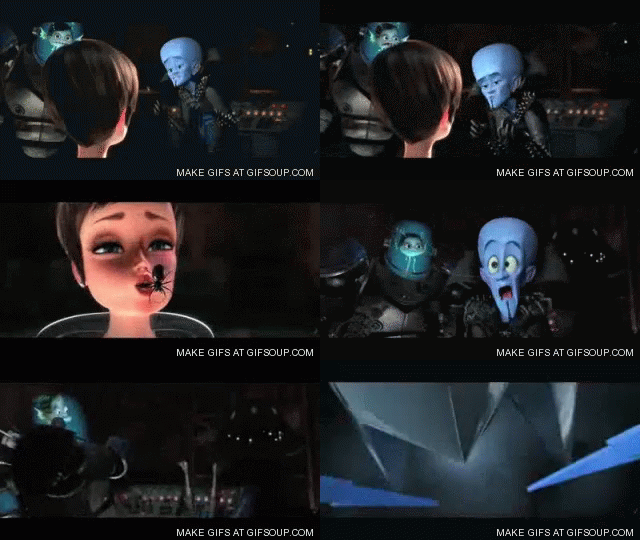
Because the introduction remains ambiguous about his unborn child, the reader is left unknowing of the fate of Chloe, allowing for the reader to immerse themselves in the raw detail of the transformation and put hope in Chloe's survival. Pinborough's use of humor and outright nasty details of Chloe as she balloons into fictional My 600lb Life type of character is successful at hooking the reader to invest into the less predictable occurrences within the story. One of my personal favorite references Matthew uses is when he describes the love of his life walking away from him after she gives him some money to go to a bar to give her some space. Because I like watching the 600lb life transformations, when he roughly says she looks like one of those obese Americans who lost weight and needs skin removal surgery, I found the rest of the story up until the point where he escapes as she dies on the floor hilarious. I also pictured the women to look like the little fat people from WALL-E, waddling like grossly fat babies wearing clothing that's clearly too small for them with little tiny purses.
This relates back to the chapter from Writers Workshop of Horror about adding humor to horror. I believe this to be an example of humor being added in a way where it can be seen as funny, but if a reader did not find it humorous it would not deter them from the story. Instead they might just feel like the description was disgusting or offensive. Matthew's undying love for Chloe as she blows up, regardless of how the reader feels about the description of what is happening to the women, reels the tone back in and adds to the likability of Matthew.
My personal favorite scene for reasons involving the humor and horror of Pinborough's writing is in chapter four, when Chloe is reaching her final form. Part of me wants to quote the whole page, but I will restrain myself to this portion:
Finally, she must have slid down the fridge freezer to sit on the floor, and then after she broke long and noisy wind, she settled down to snorting occasionally as she panted. After about half an hour, I heard something squelch, something wet perhaps, on the quarry tiles we had chosen together not that very long ago. And then there was silence. 45This portion of the paragraph demonstrates how Pinborough injects what I find disgustingly laughable humor, bathroom humor I suppose is the best name for it, infused with grotesque word choice to create something nasty. I point to the word "squelch" because I find it perfect for what is being envisioned, followed by the wet slop that follows what we, as readers, are starting to figure out in the moment. That baby isn't the baby Matthew is talking about in the prologue unless it's coming back as a mutant spider baby fetus. To bring the tone back in gracefully, Pinborough wraps it up by using Matthew's sentiment towards those now tainted tiles.
Personally, I feel the story could have ended at the end of chapter four, but she continues on creating new conflicts to give a bigger story to the spiders while still leaving the ending rather open. I would like to think that the spiders win, Matthew is just a positive ninny, and he put the spiders inside his new girl that he is driving off with which is why the dog runs away. Overall, the beginning of the story felt the most compelling to me, while the rest of the book was more or less just an intriguing thriller. The major complaint I have is there was a little drag during the survival scene at the camp, but because Pinborough added the "men inflicting women with spider babies" which, to me, was coming off very strong in her "in between the lines story", I was kept interested in the vulnerability of the women. I think the biggest mystery left open at the end is about the deafness, which I had just assumed was something to do with the spiders not being able to hive-mind with deaf things. So, in the end we're still left wondering what exactly is happening and why, but we're wrapped up enough to feel content with Matthew's personal story.
Thursday, September 5, 2019
The Funeral
In terms of categorizing Richard Matheson's short story "The Funeral," it is more a comedy than a horror. It uses classic and well known monsters to fill its' character line up which, for a short story, is a good way of describing a room full of monsters without having to spend too much time detailing them. However, the main character Morton Silkline takes the role of the lead character, starting off as what could be seen as an unlikable character. He is a mortician dealing with the dead, something people already struggle to deal with, he is a salesman, and he is good at his job.
The first impression of the character leaves the reader thinking this man, Morton the mortician, makes a living on people dying, and he makes a lot of money if he plays off grief and the monetary appearance of his guests. He sees death as a dollar sign but as he meets his next client and begins to realize something is particularly off about the guy, he shows his struggle to keep his salesman appearance through the outright strangeness that is scaring him.
Overall, the fact that the character does not really change is successful because of the humorous tone of the story. True, somewhere deep inside the man he has changed his view of the supernatural, but all-in-all he still remains the same manipulative salesman with a newly acquired clientele. Instead of feeling angry at Morton for being rewarded for his success as a salesman, the reader finds it laughable because of the predicament he has been put it. Another example of using humor to ease the horror of the situation is "Interview with the Vampire," and how the reporter is killed/turned by Lestat at the very end for having listened to Louis "whine" about his and their existence. Lestat turns the horror of the event into comedy by saying the same line he had said to Louis, as Louis had told the reporter, when he was given the "option" to be turned. Like Morton, the reporter does not really change his ways or grow in the story outside of extending his knowledge of the supernatural and his belief of it, and his predicament at the end is softened with Lestat's way of handling the situation. It leaves the reader with a "happy ending" to what is in actuality a horrific ending. While "The Funeral" does not end as grimly as "Interview with the Vampire," it does allow the reader to sympathize with the mortician and his greed.
Overall, the humor of the story was constant, which made the entire thing a joke. If Matheson had written the story without the humor, it would be interesting to see how eerie the final version would be, but it would also not satisfy the reader's need to feel for Morton. Therefore, the success of the story relies on it being classified more as comedy than as horror, but without the monsters it would not be a comedy.
The first impression of the character leaves the reader thinking this man, Morton the mortician, makes a living on people dying, and he makes a lot of money if he plays off grief and the monetary appearance of his guests. He sees death as a dollar sign but as he meets his next client and begins to realize something is particularly off about the guy, he shows his struggle to keep his salesman appearance through the outright strangeness that is scaring him.
Overall, the fact that the character does not really change is successful because of the humorous tone of the story. True, somewhere deep inside the man he has changed his view of the supernatural, but all-in-all he still remains the same manipulative salesman with a newly acquired clientele. Instead of feeling angry at Morton for being rewarded for his success as a salesman, the reader finds it laughable because of the predicament he has been put it. Another example of using humor to ease the horror of the situation is "Interview with the Vampire," and how the reporter is killed/turned by Lestat at the very end for having listened to Louis "whine" about his and their existence. Lestat turns the horror of the event into comedy by saying the same line he had said to Louis, as Louis had told the reporter, when he was given the "option" to be turned. Like Morton, the reporter does not really change his ways or grow in the story outside of extending his knowledge of the supernatural and his belief of it, and his predicament at the end is softened with Lestat's way of handling the situation. It leaves the reader with a "happy ending" to what is in actuality a horrific ending. While "The Funeral" does not end as grimly as "Interview with the Vampire," it does allow the reader to sympathize with the mortician and his greed.
Overall, the humor of the story was constant, which made the entire thing a joke. If Matheson had written the story without the humor, it would be interesting to see how eerie the final version would be, but it would also not satisfy the reader's need to feel for Morton. Therefore, the success of the story relies on it being classified more as comedy than as horror, but without the monsters it would not be a comedy.
Subscribe to:
Posts (Atom)